


What Does RTP Really Mean in Online Casino Games?
Last updated November 24, 2026
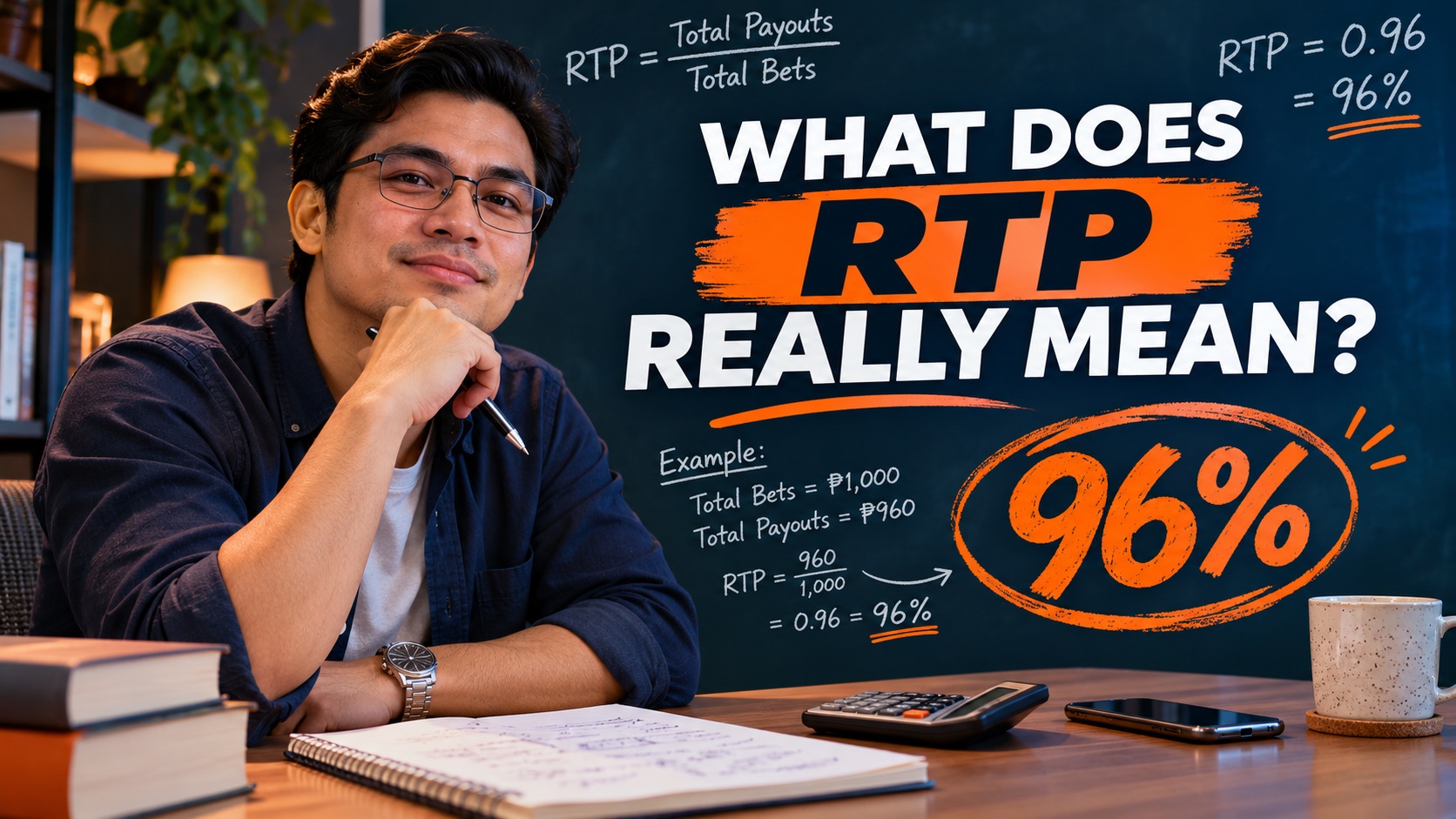
Return to player, or RTP, is the percentage of total stakes a casino game is designed to pay back over a very large number of plays. In a hypothetical game with 96% RTP, a cumulative ₱10,000 in stakes would have an expected gross payout of ₱9,600 under that model. A single player could receive much less, much more, or nothing. The figure is a mathematical average across outcomes, not a refund or a promise.
What does RTP mean in online casino games?
RTP describes the payout side of a game’s design. It is usually expressed as a percentage of the amount wagered. The denominator is total stakes, including money that gets wagered again after a payout. It is different from the amount someone originally deposited, and the difference can matter when reading a session history.
For example, a person who starts with ₱500 can wager a cumulative ₱1,000 by reusing payouts. The game’s RTP applies to that cumulative stake in the mathematical model. It cannot be used to calculate what that person will withdraw. When looking at different online casino game categories, also check whether the percentage applies to a specific version, play mode, or set of assumptions.
How is return to player calculated?
Theoretical RTP is the sum of each possible payout multiplied by its probability, divided by the stake. In a toy game with a ₱100 stake, suppose 20% of outcomes pay ₱400, 40% pay ₱40, and 40% pay nothing. The expected gross payout is ₱80 + ₱16 + ₱0, or ₱96. The theoretical RTP is 96%, and the expected net result is a ₱4 loss per ₱100 wagered. These values describe a made-up game.
For this fixed-stake model, the house edge is 100% minus RTP, or 4%. In actual games, check which bet is being measured. A side bet can have a different payout structure, and a table-game percentage may assume a particular strategy. Comparing figures makes sense only when their assumptions match.
What is the difference between RTP, RNG, and volatility?
RTP measures the average payout, the random number generator helps select outcomes, and volatility describes how widely returns can vary. They answer different questions.
| Concept | What it tells you | What it cannot predict |
|---|---|---|
| RTP | Expected gross payout as a share of stakes under the game model | Your balance after a particular session |
| RNG | How random values are generated for outcome selection in applicable games | When a win will happen |
| Volatility | How spread out outcomes or returns are around their average | The order in which losses or payouts occur |
Two titles can share an RTP and still have very different payoff distributions. One might award frequent small payouts while the other relies on rarer large payouts. Hit frequency measures how often a payout occurs. Some payouts are smaller than the stake, so a high hit frequency alone does not mean more profitable rounds.
Why can actual results differ from theoretical RTP?
Short sequences can vary widely. Consider the toy game above. Ten rounds could all pay nothing, or one could produce a large payout. Neither pattern changes the published model. Increasing play adds more money at risk and is no way to make a personal balance reach the theoretical average.
The UK Gambling Commission distinguishes designed RTP from observed RTP in its performance monitoring guidance. Observed RTP compares actual payouts with actual stakes over a defined sample. Operators can use it to investigate unusual results alongside sample size and volatility. A few personal rounds are too small a sample for that kind of inference.
Where should Filipino readers look for the RTP?
Open the exact title’s information, help, or paytable screen and look for the version and relevant mode. The UK Gambling Commission’s RTS 3 is an example of a disclosure standard. It covers access to rules, likely outcomes, and payouts. Its requirements apply within its own regulatory scope and do not verify the status of a Philippine-facing website.
Keep an eye out for two things: whether the quoted figure includes optional features and whether it matches the version on screen. A provider’s general description, an older review, and the exact game rules may refer to different builds. If the figure is missing or ambiguous, leave it unverified.
Frequently asked questions
Does 96% RTP mean 96 winning rounds out of 100?
No. It is a payout-to-stakes ratio. The proportion of rounds with any payout is a separate measure.
Does higher RTP guarantee more winnings?
No. A higher percentage means a higher theoretical return under comparable assumptions. Actual results can still be losses.
Can a losing streak raise the chance of winning next?
In independent rounds with unchanged rules, previous losses do not change the next round’s odds.
Is RTP the same as the payout limit?
No. A payout limit is a cap on a possible payout. RTP averages payouts over all possible outcomes.
Can the same title show different RTP values?
Versions, modes, and configurations may differ. Use the figure disclosed for the exact version you are examining.
What should you remember before risking money?
Read the paytable, check the stated assumptions, and separate the expected return from what can happen in one session. An RTP percentage is no reason to play longer, chase a loss, or use money needed for bills. If the game’s terms are unclear, skipping it is a reasonable choice.

Kami adalah tim BK8. Dalam dunia penulisan, kami sudah memiliki pengalaman lebih dari 15 tahun, terutama dalam bidang judi dan casino online. Hampir semua artikel seputar casino online sudah pernah kami ulas seperti permainan poker, slot, tembak ikan, dan masih banyak permainan lainnya.